The Village of Swynnerton
The Village of Swynnerton
‘The History, Gazetteer and Directory of Staffordshire’ by William White in 1851 described Swynnerton as…
“… a small neat village, in an elevated and healthy situation, four miles NW by W of Stone, giving name to a parish extending upwards of six miles in length from north to south, but only from one to two miles in breadth, and containing about 4825 acres of land.“
The Reverend Brian Swinnerton, one-time curate of St Mary’s Swynnerton and a founder member of the Swinnerton Family Society, wrote in his 1971 booklet Swynnerton and the Swynnertons that ‘the village or first settlement hereabouts probably dated from prehistoric times, and was situated on the site of the Saxon King Wulfhere’s fortress at the high point to the east called Bury Bank. However, the later Norman and mediaeval village was hard by the castle on the low ground to the south of the present village. Although the original manor of Aslen, first Lord of Swynnerton, had been the royal residence of a Saxon Prince, it was probably a low wooden building surrounded by a moat and a palisade of pointed stakes. Aslen and his sons had begun the building of Swynnerton Castle to afford themselves security. As the Norman residences of the period were of an almost standard design, the Lords of Swynnerton probably followed the same building pattern. A moat, drawbridge and bailey (courtyard) served the ends of aggression. The living quarters were found in the Great Hall, while the bakehouse, salt house, bath house etc., were also clustered within the bailey. The centuries brought alterations, until Swynnerton Castle evolved into a fortified manor house.’
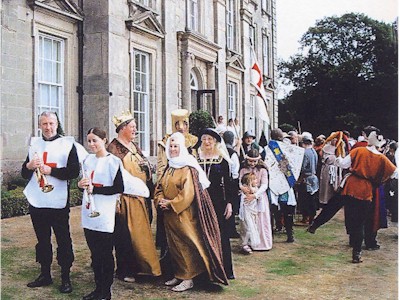
A charter was granted by Edward I to Sir Roger de Swynnerton on August 15th 1306 for the holding of an annual fair in the village of Swynnerton, on the feast of the Assumption of Mary, the mother of Jesus. The 700th anniversary of that event was celebrated by the holding of a Medieval Festival and a reenactment of the Charter ceremony at Swynnerton in 2006.
This photograph of the re-enactment (pictured), shows Lord and Lady Stafford in the front row playing the King and Queen, and Roger and Elizabeth Swynnerton behind them playing Sir Roger and Margaret.
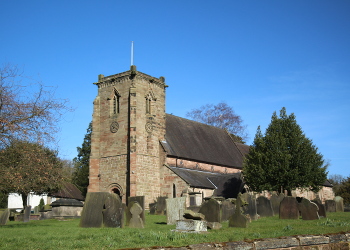
A Saxon church or chapel certainly stood on the site, as traces of the old Saxon building can still be seen in the otherwise Norman arch which gives entrance to the church. This Saxon building was either destroyed in William the Conqueror’s devastation of Staffordshire following the Battle of Stafford in 1069, or Aslen and/or his sons built a new one around it. There was certainly a church or chapel of some kind there by the 1150s, as Robert Fitz Aslen ceded it to the monks of Stone at that time.
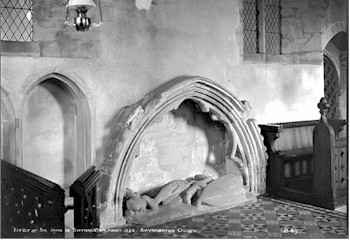
When Sir John Swynnerton returned from the Crusades he rebuilt the old Chapel in thanksgiving for his safe return. His tomb (pictured) can still be seen in the chancel of the church today. Traces of the old Saxon building can still be seen in the otherwise Norman arch which gives entrance to the church. His tomb (see right) can still be seen in the chancel of the church today. The church was repaired and enlarged in 1844. In the Fitzherbert Chapel adjoining the chancel, where the earlier Fitzherberts were buried, is an eight-foot high statue of Christ suffering as a mock king. Legend has it that this was buried by the villagers to prevent it being vandalised or destroyed by Cromwell’s troops. It was dug up after the Restoration and placed over the main door of the church, and subsequently rehoused in the chapel.
Sir John’s descendants continued to live in the old castle even after the last of the original line, Humphrey Swynnerton, died without a male heir on the 25th August 1562, as the estate had passed to the Fitzherbert family by the marriage of Humphrey’s younger daughter Elizabeth to William Fitzherbert, son of Sir Anthony Fitzherbert of Norbury in Derbyshire, in 1562. However, the Fitzherberts were staunch Catholics, and the end came for the old castle in 1643 when the village was burnt, and the castle reduced to rubble by Parliamentary troops led by Colonel Stone.
A new manor house was built on the present site after the Restoration of 1660, but between 1725 and 1729 this was greatly extended by Thomas Fitzherbert. This is the present Swynnerton Hall, and is the home of the Society’s Patron, Francis Melfort William Fitzherbert, Lord Stafford, the title having passed to this branch of the family on the death of Fitzherbert Stafford Jerningham of Costessey Hall, Norfolk, in 1913. By all accounts the remains of the old castle still remained for a century and a half, however, and were only finally removed in around 1812, when another Thomas Fitzherbert had the whole village moved to the back of the new Hall so that he could enjoy untrammelled views!
Close to the Hall is Our Lady of the Assumption Parish Church, a handsome Catholic chapel in the Gothic style, commissioned in 1868 by Maria Teresa née Gandolfi, widow of Francis Fitzherbert, and designed by Gilbert Blount. Maria Teresa’s son Basil erected a side altar in her memory after her death. The chapel has an elaborately rich roof, a small house for the chaplain, and a handsome tribute for the family.