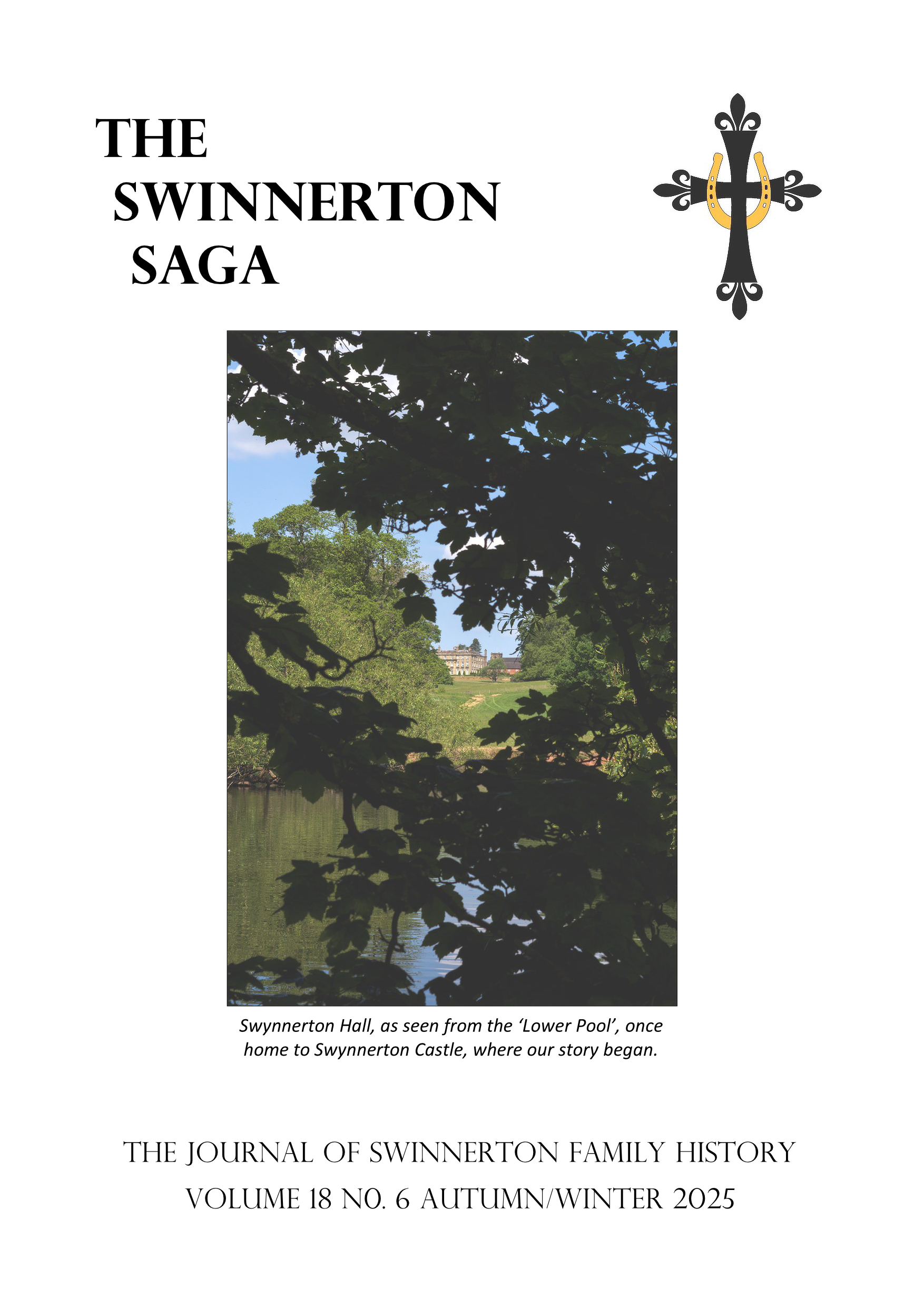
This article was first published in the Winter 2024 edition of the Saga, Vol. 18 No. 4, and is the first in a three part history of the ‘new’ Swynnerton Hall and the old Swynnerton Castle.
This article wasn’t intended to be quite as long as it turned out, but as you’ll see, the simple question – ‘when was Swynnerton Hall built?’ – turned out not to have quite a simple answer! A week or so ago, our chairman Julian received an email from a Mr John Diley, who, with some professional help, had traced one of his ancestors back to our area, and discovered that he had been married in Eccleshall Church as a ‘papist’ – the PRO entry reads “1714 – 21 Mar – Andrew Doley & Elianour Bohun by a papist priest married by banns at Holy Trinity P.C. Eccleshall (Staffs)”. Intrigued by this, and on discovering the Fitzherberts of Swynnerton Hall were Catholics, he emailed Julian, asking whether he thought Andrew and Elianour might have been secretly married in the chapel at Swynnerton Hall.
Julian’s immediate response, and mine separately, was, of course, that the Fitzherberts’ Our Lady of the Assumption Catholic chapel wasn’t built until 1879. John then asked if the Fitzherberts might have had a private chapel within the Hall in which they allowed locals to take Mass. Our answer to this was equally straightforward, that the current Hall wasn’t built until 1729, replacing one that had been demolished in 1644 by parliamentary troops. Ordinarily, that would have been that, but I did do a quick search to doublecheck the facts – and discovered that our responses had in part been wrong.
In fact, that quick search on the history of the Hall, both on the internet and within the back issues of the Saga, proved ambiguous. Most authorities have it that the current Swynnerton Hall was indeed built in 1729, but other sources said that the previous manor house, generally known as Swynnerton Castle, was rebuilt after the Restoration of King Charles II. However, opinion was divided even on this – some say the old castle was rebuilt, others that the Fitzherberts started anew on the site of the current Hall, while others say that a new Hall was built, but it was later replaced by the current Hall.
After getting nowhere on the internet, I decided to see if there was anything useful in Dad’s archive on the subject, and I immediately struck gold. Among the various Swinnerton-related booklets, I found Vol. 9 of the Journal of the Staffordshire Catholic History Society, printed in 1967, entitled Swynnerton Catholic History, written by one T.B. Trappes-Lomax in 1961. Now, some of you may be very familiar with this publication, but it was a new one on me. As its name suggests, the booklet is a history of the Catholic side of Swynnerton life. It mainly focuses on the Fitzherberts, starting at their inheritance of the estate on the death of Humphrey Swynnerton in 1562, when his daughter Elizabeth, heiress of Swynnerton, married William Fitzherbert (b. 1520).
T. B. Trappes-Lomax turned out to be Brigadier Thomas Byrnand Trappes-Lomax CBE (1895-1962). He had dedicated the booklet to the memory of his mother, Alice Fitzherbert, the sister of Francis Fitzherbert (1859-1932), who became the 12th Baron Stafford in 1913 when his uncle the 11th Baron died without issue. This excited me, because I presumed the Brigadier had access to the Fitzherbert records kept at Swynnerton Hall, which are studiously private, and are not on the internet. Indeed, many of his notes referred to these records, as had Canon Bridgeman and the Revd Charles Swynnerton in the century before. I therefore had high hopes the pamphlet would be historically accurate, and so, in the main, it proved to be.
As many of you will know, the old Swynnerton manor house, often known as Swynnerton Castle, was destroyed by an order of Parliament dated 29 Feb 1644. Some authorities have this as 1643, but the Visitation of Staffordshire (1798) definitively says 1644. The order says “that Keele House be forthwith demolished by Capt. Barbar’s souldiers, and that Mr. Fitzherbert’s house, of Swinnerton [sic], be forthwith demolished by captaine Stone’s souldiers.”
According to local Staffordshire historian Alan Rawlings, ‘the old castle was finally demolished in 1760, together with the cottages around Castle Lake, and the stone incorporated into the building of the new village. When the lake was drained and dredged in 1938, the substantial foundations of the castle were revealed.’ (Saga Vol. 12 No. 15, August 2015)
The lake, which sits to the south of the present Swynnerton Hall, and which the Brigadier calls ‘Lower Pool’, was originally the moat around the old manor house, or Swynnerton Castle. I presume the village was moved after Thomas Fitzherbert commissioned Lancelot ‘Capability’ Brown to devise a plan to remodel Swynnerton Park in 1758, although as mentioned in the previous article, his plans weren’t fully enacted.
At the time of its initial destruction, the old manor house was occupied by Sir William Fitzherbert (b. 1608). He had inherited it as a four-year-old on the death of his father Edward, who, in the same year of 1608, had bought the estate for £800 from his grandmother Elizabeth, daughter of Sir Humphrey Swynnerton, widow of William Fitzherbert, and owner of the Swynnerton estate. After William died, Elizabeth had married Francis Gatacre, of Gatacre near Bridgnorth. According to the Brigadier, Francis ‘certainly lived at Swynnerton between 1564 and 1567, since three of his children were baptised there within those years. In 1577 he succeeded his father in the ownership of Gatacre, and it is perhaps reasonable to suppose that he would have wished his children to be brought up in their ancestral home.’
Presumably Elizabeth initially wanted to stay at Swynnerton with her young son Thomas, who was only ten when his father died. However, it’s possible he didn’t move with her to Gatacre, as he was sent to Oxford ‘in his 16th year’ – but more of that below. However, on her second husband’s death in 1599, the Brigadier presumes she must have moved back to Swynnerton, as she died there in 1616, and is buried at St Mary’s church.
The reason Sir Humphrey’s son Thomas didn’t live there after his mother’s death, and that his son Edward effectively bought him out, was that this was that Thomas Fitzherbert, the renowned Jesuit, who the Brigadier says had been a Catholic zealot ever since his brief time at Oxford in 1568. I’m wondering if it’s possible that he was becoming fanatical before that, though. His mother was by all accounts a devout and pious Catholic, and brought up her son to be the same, but his new stepfather Francis Gatacre was more defiant in his beliefs – according to the Brigadier, he was ‘imprisoned as a recusant in 1575-76, occurs as a papist at Swynnerton in October 1585, and appears in the first recusant roll of 1592-3’. Maybe Francis ‘radicalised’ the young Thomas, to use the modern phrase?
Thomas did live at Swynnerton, albeit briefly, according to the Brigadier – he was imprisoned in 1572 for recusancy, and on his release he returned to Swynnerton. However, many more accusations followed, and after living in hiding for a few years, he fled to London in 1580 with his new wife Dorothy, heiress of Bledlow in Buckinghamshire, before fleeing the country in 1582, never to return, and eventually dying in Rome in 1640. I have so far found no reference as to whether the young Edward went ‘on the run’ with his father, or whether his grandmother insisted he remain with her. Either way, he was obviously at Swynnerton in 1608, when he bought the estate.
So, back to the events of 29 Feb 1644, when the home of the now 36-year-old Sir William was destroyed (I presume he was knighted for his services to the King, having risen to Colonel in the Royalist forces). According to Norbury Manor House, Derbyshire by Maxwell Craven, he went to Bledlow in Buckinghamshire, which he had inherited on the death of his grandfather Thomas in 1640. This was a costly move, however, as in 1647 he had to pay £200 in order to keep the estate from being sequestered by Parliament, as did many former Royalist nobles and gentry. According to the same book, William was still in dispute about this 18 months later when he inherited Norbury in Derbyshire. It seems that a year earlier, in 1648, Sir William had agreed a settlement with his cousin, Sir John Fitzherbert, that Norbury would go to him on Sir John’s death, the latter having no heirs. This happened quicker than was probably expected, as Sir John died at Lichfield in 1649. Most sources say that he died in battle, but the Royalist garrison there finally gave in after Charles I surrendered in 1646, so it’s more likely that Sir John died of an illness. Either way, Sir William Fitzherbert now had a new home to go to, and Norbury was much nearer to Swynnerton. According to the same book, ‘that he immediately repaired to Norbury himself, along with his wife and family seems certain, Swynnerton having been destroyed. During the Commonwealth he spent much time and money trying to recover the Padley estate [see below] to help with his finances, but to no avail. Norbury must have seemed a little neglected, and may have been abused by passing Parliamentary soldiery, but the house was almost certainly habitable. Thus William saw out the Commonwealth there, and was still in residence when the hearth tax return was made in 1664.’
Padley was once owned by the Fitzherbert family, but was seized by the Crown after another John Fitzherbert, and another Sir Thomas Fitzherbert, both notorious recusants, were imprisoned for their beliefs. John died in Fleet prison, while Sir Thomas died in the Tower of London. Padley was restored to Sir William in 1649, but he was soon forced to sell it to pay the family’s mounting recusancy fines and heavy debts, and never managed to get it back.
Now, most authorities, including Burke’s Peerage, say that Sir William died in 1662, but the Brigadier disagrees, saying it was after 1664, possibly because he knew about the hearth tax of that year. Another commentator, however, in the notes on a Fitzherbert Wikitree, revealed that Sir William ‘was named as joint executor with his daughter Bridget Bartlett of the will of her father-in-law Rowland Bartlett in 1665. He did not prove the will, but power was reserved to him in 1667 to apply for administration…. [which] indicates he was still living in 1667.’ This will is at the National Archive at Kew.
This brings us back to the building of the new Swynnerton Hall. As I said, most sources say that it was built in 1729, but other sources disagree, including the Brigadier: ‘William lived there [in Norbury] – his wife was buried there in 1653 – until on the restoration of the Monarchy in 1660, with the resources of both the Swynnerton and Norbury properties at his back, he felt able to embark on the rebuilding of his home. He abandoned the lowlying position of the old house, and chose a new site on the high ground near the church which his grandfather had refused to enter, commanding one of the most magnificent views enjoyed by any house I know, westward to the Wrekin and the Welsh hills and south over Stafford Castle, which was to pass 250 years later into the possession of his descendants.
‘What survives of his building proves that he chose an E-shaped ground plan, whose fingers were to disappear at the next reconstruction of the house behind a straight Palladian front; this covers the sundial with which he was at pains to provide himself over the porch in the central finger of the ‘E’, and on which is believed to be the date 1661. In a list of the gentry of Staffordshire drawn up in 1662 or 1663, he is described as a ‘very loyal Roman Catholic’ and a ‘very prudent man’. He was presumably dead before 1666, since it was his son Basil who was assessed in that year for tax on fifteen hearths in the new Swynnerton [Hall].’
There are two problems with this, however. As we’ve seen, William was still alive in 1667, so if he was living at Swynnerton, it would have been his name on the hearth tax, and not his son Basil’s. He was certainly the owner of Swynnerton, and may even have planned the new building, but as his name was on the 1664 Norbury Hearth Tax, he almost certainly remained there, handing over the responsibility of actually building Swynnerton Hall to his son Basil (b. about 1630, according to the Brigadier). Once the new Hall was built (probably finished in 1663), however, Norbury was ‘reduced to a secondary seat, and [eventually] much of the medieval house was demolished, and replaced by a brick-built house constructed around 1680.’ (Architectural Data Service: Norbury Old Manor, Derbyshire: Archaeological Survey and Assessment)
As for the ‘rebuilding’ of 1729, this was undertaken by another Thomas Fitzherbert, grandson of its builder Basil. According to the Brigadier, ‘…Thomas Fitzherbert embarked on the enlargement of the E-shaped house which had been built immediately after the Restoration. The evidence is the Cliffords’ statement in their [book] Parish of Tixall, which they published in 1817, that Swynnerton had been rebuilt about 60 years ago.
‘Tixall is only fifteen miles from Swynnerton, and it was the Cliffords’ home. Michael Jones, the antiquary, who in 1829 stayed at Swynnerton, and compiled a manuscript account of the family, noted that no architect’s drawings or correspondence relative to the work survived, and hazarded a guess that it may have taken place about 1725-29, but in the absence of any evidence to support the earlier dating, the Cliffords’ statement must stand. Thomas Fitzherbert’s additions, which involved extending the house westwards and roofing the space between the long projections of the E, thus obscuring the sundial over its central projection, did not, as far as is known, include a chapel. Some room presumably served that purpose, perhaps the same room that had done duty in the earlier building.’
This is possibly where the oft-quoted 1725-29 date comes from, but 1725 makes sense, as Thomas’s father William, Basil’s son, died in 1724. Thomas must have put plans in motion soon after he inherited, which suggests he’d been champing at the bit for some time!
So now, finally, we return to Mr Diley’s original question – would it have been possible for a local Catholic to have had a private ceremony at the Fitzherberts’ private chapel in Swynnerton Hall in 1714?
We know now that the present Hall is a remodelling of the original new Hall built in the early 1660s, which was still very much in place in 1714. We also know from the Brigadier that there was a private chapel within both the hall of 1663, and that of 1729. Furthermore, according to Murders, Myths and Mysteries of North Staffordshire by W. M. Jamieson (previously mentioned in Saga Vol. 11 No. 6, April 2000), ‘in the Catholic church is a plaque transferred from the room in Swynnerton Hall which served as a private chapel for those worshippers who, during the religious strife, refused to attend the so-called ‘reformed’ church.’
So the answer to Mr Diley’s question is twofold. Firstly, they couldn’t have been legally married in the Hall, because Catholic churches and/or chapels weren’t sanctioned for marriages until the Catholic Emancipation Act of 1829. So they were legally married in the church at Eccleshall, as stated in the Parish Records that he discovered.
However, they could have had some kind of blessing from the Fitzherberts’ resident priest of the time. The Brigadier confirms Mr Diley’s research that this was the Revd Thomas Adams, who lived at Swynnerton Hall from 1705 until 1720, when he went blind, and could no longer conduct Mass.
This doesn’t mean the blessing happened, of course, but we now know that it isn’t impossible.